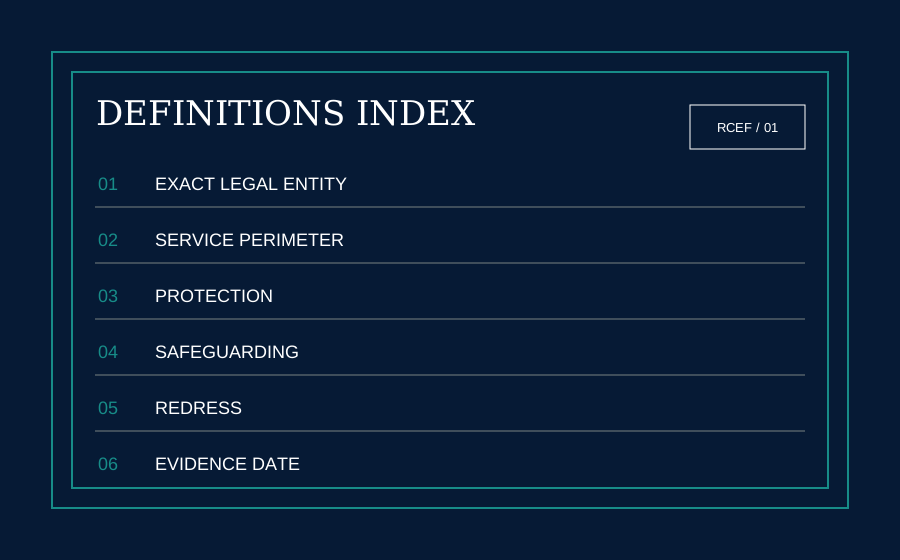
DEFINITIONS LAYER

RCEF Taxonomy

A developing common language for identity, evidence, protection, safeguarding, complaints and redress.

INDEX PLATE

Definitions protect distinctions.

The taxonomy prevents identity, protection, safeguarding and redress from collapsing into one ambiguous claim.

ALPHABETICAL INDEXCEHILMOPRST

Words carry scope.

Each definition is paired with the distinction it protects and the conclusion it must not be used to imply. Terms remain subject to versioned methodology governance.

C

Complaint route

The documented path by which a complaint reaches the entity responsible for receiving and responding to it.

Why it matters

A brand-level contact page may not identify the accountable legal entity or escalation path.

Does not imply

It does not itself establish an external or statutory redress entitlement.

Client protection

A defined legal, contractual or operational protection potentially available to an identified customer for a specified service.

Why it matters

Protections depend on entity, client category, product, jurisdiction and date.

Does not imply

It does not mean all losses are covered or that protection is unconditional.

E

Evidence character

A field-level description of how a statement is supported, from not evidenced through independently corroborated or outcome evidenced.

Why it matters

Different fields can rest on evidence of different strength and type.

Does not imply

It is not an overall score, approval or conclusion about a firm.

Evidence date

The date on which a source was issued, accessed, reviewed or stated to apply.

Why it matters

Authentic evidence can become stale or cease to match the relevant service.

Does not imply

It does not imply continuous accuracy after that date.

Exact legal entity

The incorporated or otherwise legally constituted person responsible for the relevant service or obligation.

Why it matters

Websites and group brands can involve several entities with different permissions and duties.

Does not imply

It does not include every affiliate that shares branding, ownership or directors.

H

Historic state

A preserved earlier version of a record, field or conclusion with its applicable dates.

Why it matters

History makes corrections and material changes traceable rather than invisible.

Does not imply

It does not represent the current position unless expressly marked current.

I

Institutional evidence

Structured, source-aware information prepared for legitimate institutional use within a defined scope.

Why it matters

Institutions need traceability, limitations and change history rather than promotional summaries.

Does not imply

It does not replace the institution’s own legal, risk or due-diligence judgement.

L

Limitation

A stated boundary, uncertainty, exclusion or gap affecting how evidence may be interpreted.

Why it matters

Readers need to know what was not tested, unavailable or outside the review.

Does not imply

It is not automatically an adverse finding.

M

Material change

A development capable of affecting identity, permission, scope, protection, safeguarding, complaints, redress or the reliability of a published field.

Why it matters

A previously accurate record may require review when its underlying facts change.

Does not imply

It does not mean misconduct or predetermine a programme decision.

O

Official identifier

A number or code assigned by an authoritative corporate, regulatory or public body to a specific entity or record.

Why it matters

Identifiers help distinguish similarly named entities and connect sources.

Does not imply

It does not establish the scope or current effect of a permission by itself.

Observatory record

A public-source case, regulatory-status, methodology-learning, material-change or historical record published for research and institutional memory.

Why it matters

It separates learning from programme participation and preserves source context.

Does not imply

It does not imply admission, endorsement or a current assessment.

P

Programme record

A programme-specific record governed by the applicable RMCA module and publication controls.

Why it matters

FDRC and PSCR address different market questions and must retain separate scope.

Does not imply

It does not transfer to another entity, programme, product or jurisdiction.

R

Redress route

A documented route through which eligible complaints may reach an external body, court, scheme or other remedy mechanism.

Why it matters

Complaint handling and external redress may involve different entities, criteria and jurisdictions.

Does not imply

It does not guarantee eligibility, acceptance, compensation or outcome.

Regulatory permission

A permission, authorisation, registration or licence recorded by the relevant authority for an identified entity and activity.

Why it matters

Permission language, territorial effect and customer scope differ across regimes.

Does not imply

It does not establish protection for every service or customer and is not an RMCA status.

Relevant funds

Funds identified within the applicable legal or operational safeguarding scope for a defined service and customer relationship.

Why it matters

The classification may determine which controls and records are relevant.

Does not imply

It does not mean every amount handled by a group is safeguarded in the same way.

S

Safeguarding

Arrangements intended to protect or segregate relevant customer funds under a defined legal, operational and temporal scope.

Why it matters

The responsible entity, method, jurisdiction and evidence date must be clear.

Does not imply

It is not a deposit guarantee, solvency guarantee or universal client protection.

Service perimeter

The precise product, service, customer type, jurisdiction and delivery arrangement to which a statement applies.

Why it matters

One entity can provide multiple services under different permissions and protections.

Does not imply

It does not extend beyond the stated scope by association.

T

Trading name

A brand or name used publicly that may differ from the exact legal entity entering the contract or providing the service.

Why it matters

Readers can otherwise mistake brand recognition for entity identity.

Does not imply

It is not necessarily a company, permission holder or accountable entity.